ChatGPT vs Google Search: How AI Is Changing Search & SEO in 2026
ChatGPT vs Google Search: understand how AI is changing online search in 2026 and what businesses should do for SEO, local search and AI visibility.
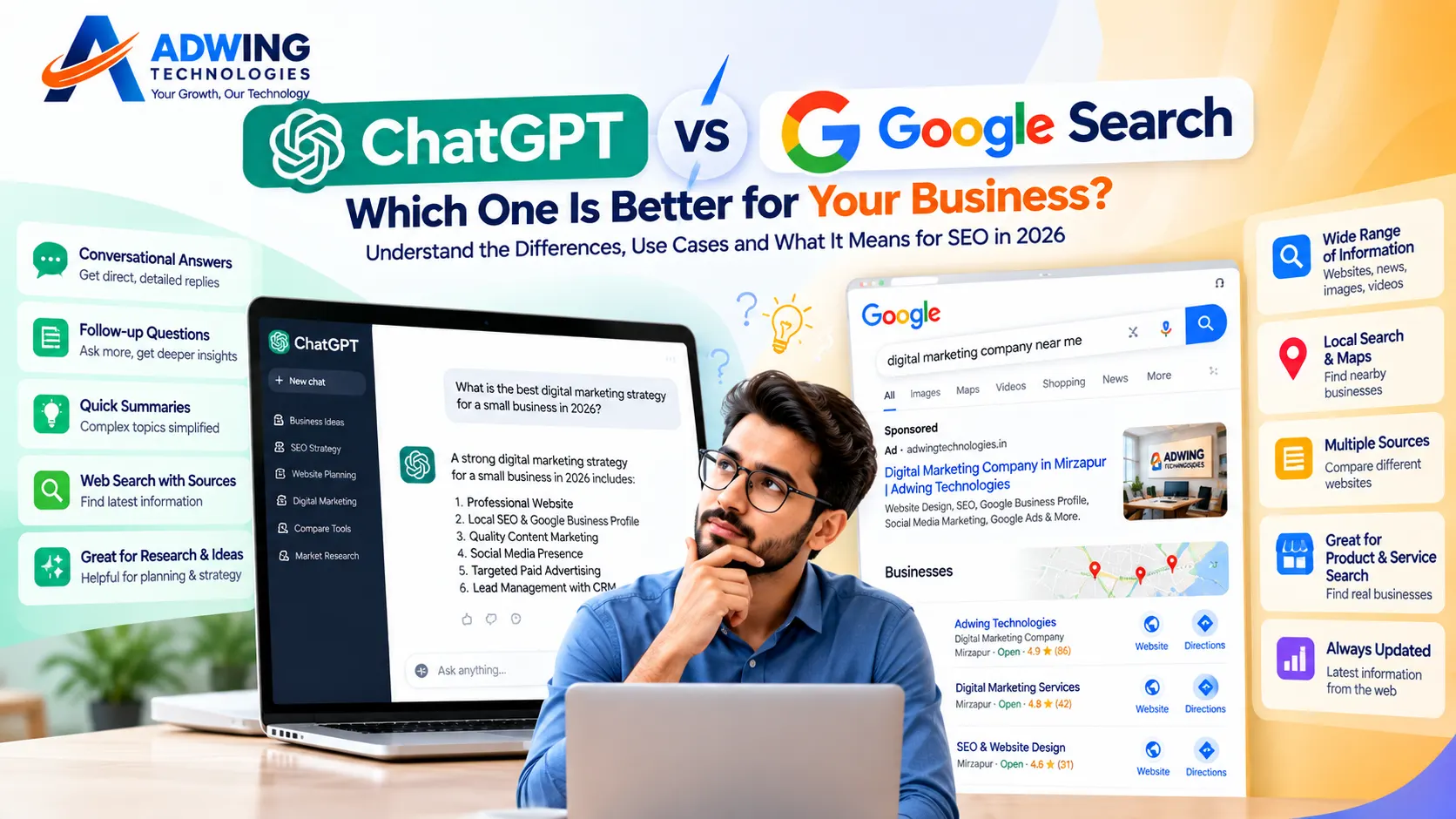
ChatGPT vs Google Search: How AI Is Changing the Way People Find Businesses Online
For years, searching online followed a familiar pattern. A user opened Google, typed a few keywords, reviewed several results and visited websites to find the required information.
That behavior is changing.
Today, users can ask detailed questions in natural language and receive an organized answer directly from an AI-powered interface. At the same time, Google itself has integrated generative AI deeply into Search through AI Overviews and AI Mode. Google Blog
This creates an important question for businesses:
Should you optimize your website for Google Search, ChatGPT, or both?
For most businesses, the practical answer isn't to abandon one platform for another. It is to understand how search discovery is becoming multi-platform and make your business information easy to discover, understand and trust wherever potential customers search.
What Is Google Search?
Google Search remains a web discovery system built around crawling, indexing and serving relevant results.
Google explains its core process in three stages: it discovers web content through crawling, analyzes and stores eligible content through indexing, and then serves results relevant to a user's query. Ranking considers many signals and can vary according to factors such as location, language and device. Google for Developers
For a business, Google can surface multiple forms of visibility, including traditional organic results, local results, websites, images and AI-powered search experiences.
This makes Google particularly important for searches with strong local or commercial intent.
Consider searches such as:
“website designer near me”
“digital marketing company in Mirzapur”
“pathology software company”
“restaurant POS software”
“school website developer”
A well-optimized business can potentially be discovered through several Google surfaces depending on the query.
What Is ChatGPT Search?
ChatGPT has evolved beyond answering solely from its underlying model knowledge.
When web search is used, ChatGPT can retrieve current information from the web and provide a conversational response with links to relevant sources. Users can also continue with follow-up questions while maintaining the context of the conversation. OpenAI
This changes the interaction.
Instead of:
Search → Open several websites → Compare information → Search again
a user may increasingly use:
Ask → Receive an organized answer → Ask follow-up questions → Explore cited sources → Decide the next step
That difference has major implications for businesses and content creators.
ChatGPT vs Google Search: What Is the Real Difference?
The difference is becoming less clear-cut because Google now provides conversational AI experiences too.
A useful way to understand today's landscape is this:
| Area | Google Search | ChatGPT Search |
|---|---|---|
| Traditional web results | Core strength | Not the traditional interface |
| Conversational answers | Available through AI Search experiences | Core interaction model |
| Follow-up questions | Supported in Google's AI experiences | Natural part of chat |
| Source links | Available across Search experiences | Can accompany searched answers |
| Local discovery | Strong Google ecosystem | Can search the web for relevant information |
| Maps/local intent | Major Google strength | Different discovery experience |
| Complex explanation | Increasingly AI-assisted | Strong conversational use case |
| Research workflow | Search + AI features | Conversation + web sources |
| Website discovery | Central to the product | Sources can lead users to websites |
The important takeaway is that Google is becoming more conversational while conversational AI is becoming more connected to the live web. Google Blog
The two experiences are moving closer together in some areas rather than remaining completely separate categories.
Google Search Is Already Becoming AI Search
Businesses should not think of this transition as simply “ChatGPT replacing Google.”
Google has been integrating generative AI directly into Search.
In 2026, Google said Gemini 3 became the default model for AI Overviews and added the ability to move from an AI Overview into follow-up conversation. Later updates have continued expanding AI Mode and AI-powered discovery. Google Blog
Google reported in June 2026 that AI Overviews had more than 2.5 billion monthly active users, while AI Mode had passed one billion monthly users. These are Google's own reported usage figures and should be understood as such. Google Blog
For marketers, this means AI search is no longer a future SEO discussion. It is part of today's search environment.
How Search Behaviour Is Changing
Traditional search often begins with short keyword phrases.
For example:
“SEO company Mirzapur”
Conversational search makes much more detailed questions practical:
“Which digital marketing services should a small business in Mirzapur start with if it wants more local enquiries?”
Or:
“What should I check before choosing billing software for my retail shop?”
Or:
“Which features should a school website have for admissions, notices, results and parent communication?”
The user's underlying need may be similar, but the way the question is expressed is very different.
Google itself says people are using AI Search to ask new types of questions, while ChatGPT Search is explicitly designed to support natural-language questions and contextual follow-ups. Google Blog
Does This Mean Traditional SEO Is Dead?
No.
The technologies may change, but AI systems still need information to work with.
Google still crawls and indexes web pages, and ChatGPT's search documentation states that websites wanting to be eligible for inclusion in ChatGPT Search should allow OAI-Searchbot to access their content. Neither platform guarantees placement. Google for Developers
So businesses still need strong digital assets.
That includes a technically accessible website, useful original content, clearly structured service information, strong business details, relevant internal linking and trustworthy supporting information.
What is changing is how that information may ultimately reach the user.
From SEO to Search Everywhere Optimization
Businesses traditionally concentrated heavily on ranking ten blue links on Google. That approach is becoming too narrow. A modern business should think about visibility across:
Google organic search • Google Maps/local discovery • AI Overviews • AI Mode • ChatGPT Search • social platforms • industry websites • trusted third-party mentions
The objective is no longer merely:
“How do we rank this page?”
A better strategic question is:
“Can search and AI systems clearly understand who we are, what we provide, where we operate and why this page is useful?”
That is a much broader digital-marketing challenge.
How Should Businesses Prepare for AI Search?
Businesses don't need to rewrite every page for robots. They need to make their online information clearer and more useful for people—which also makes it easier for search systems to understand.
Create Content That Directly Answers Real Questions
Instead of writing generic pages filled with repetitive keywords, answer questions customers actually ask. For example, a pathology software provider could publish:
What features should pathology lab software include?
A restaurant software company could answer:
How does KOT billing work in restaurant POS software?
A website agency could explain:
How much does a business website cost and what should the package include?
Specific questions create useful content for both conventional and conversational discovery.
Stop Writing for Keyword Density Alone
Repeating an exact keyword dozens of times does not make an article more useful. The page should naturally establish its subject through the title, headings, supporting terminology, examples and detailed explanations.
For example, an article targeting Digital Marketing Services in Mirzapur can naturally discuss:
local SEO, Google Business Profile, website optimization, Google Ads, social media marketing, lead generation and local business visibility. That creates topical depth without forcing the same phrase into every paragraph.
Build Topic Authority, Not Isolated Blog Posts
Suppose a company wants visibility for website development. Instead of publishing one enormous page containing every possible keyword, it could develop interconnected resources around:
Website Design
Business Website Development
eCommerce Website Development
School Website Development
Hospital & Clinic Websites
Restaurant Websites
Website Redesign
Local SEO
Website Speed & Security
Then these pages can connect naturally through internal links. This helps users navigate related information and creates a clearer site structure for search engines.
Local Businesses Still Need Strong Google Visibility
AI discovery does not eliminate the importance of local search. Google says relevance can depend on location, language and device, and the type of search features shown changes according to the query. Google for Developers
For businesses serving specific cities, that makes local signals particularly important. A company serving Mirzapur, Varanasi or Prayagraj should clearly communicate its real service areas and services through its website and appropriate local business presence.
Google Business Profile, customer reviews, accurate contact information, location/service information and locally relevant website content remain important parts of that ecosystem.
Your Website Becomes More Important, Not Less
There is a misconception that if AI provides answers directly, businesses no longer need websites. A professional website remains the place where a business can establish its own detailed information, service pages, product documentation, case studies, FAQs, contact options and conversion journey.
Search platforms can introduce a potential customer to your business.
Your website has to convert that interest into trust and action.
That means businesses should invest not only in traffic acquisition but also in:
Clear positioning → Useful content → Strong service pages → Trust signals → Fast mobile experience → Easy enquiry → WhatsApp/Call/Form CTA
Search Visibility and Conversion Are Different Problems
Ranking is not the final business objective. Neither is appearing in an AI-generated answer. The real commercial journey looks more like:
Discovery → Understanding → Trust → Website Visit → Enquiry → Follow-up → Conversion
A business may have excellent search visibility but still generate weak results if its website is slow, confusing or lacks a clear next step. This is why SEO, website development, Google Business Profile management, advertising, content and CRM should not operate as completely disconnected activities.
What Does AI Search Mean for Digital Marketing Agencies?
Digital marketing agencies need to evolve beyond simply delivering keyword reports. The modern role increasingly includes:
Technical SEO
Local Search Optimization
Content Strategy
Structured Website Architecture
Entity and Brand Consistency
Conversion Optimization
AI Search Visibility
Analytics
Reputation Building
Lead Management
This transition creates an opportunity for agencies that focus on complete digital visibility rather than isolated ranking tactics.
What Adwing Technologies Recommends for Businesses in 2026
For businesses building their online presence, the practical strategy is not ChatGPT OR Google.
It is to build a strong source of business information that can work across today's discovery ecosystem.
At Adwing Technologies, our approach combines:
Professional Website Development
Search Engine Optimization
Local SEO
Google Business Profile Optimization
Content Marketing
Google & Meta Advertising
Business Software & CRM Solutions
The goal is to connect discovery with enquiry and business operations.
For example:
Google / AI Search → Website → WhatsApp or Enquiry Form → CRM → Follow-up → Customer
That is more valuable than chasing traffic without a conversion system.
ChatGPT vs Google Search: The Future Is Not One Search Box
The biggest change in search may not be one company replacing another. It is that users now have more ways to discover information.
Someone may discover a business through Google Maps today, ask ChatGPT for detailed guidance tomorrow, watch a social-media video later, and finally return through Google to contact the company.
Businesses therefore need a digital presence that remains consistent and useful across multiple discovery points.
Google continues to evolve toward AI-assisted and conversational search, while ChatGPT Search combines conversational interaction with current information and web sources. Google Blog
For businesses, the lesson is straightforward:
Don't optimize only for a search engine. Build a digital presence worth discovering.
Prepare Your Business for the New Search Era
If your business depends on online enquiries, your website and digital-marketing strategy should be prepared for both traditional search and emerging AI-powered discovery.
Adwing Technologies helps businesses build professional websites, improve local and organic visibility, strengthen Google Business presence and create digital systems designed around lead generation.
Adwing Technologies – Digital Marketing & Website Solutions
Adwing Technologies
Website Development • SEO • Google Business Profile • Digital Marketing • Business Software